Retail returns have grown into a major supply chain challenge, creating costs that extend far beyond transportation and warehouse handling. As return volumes continue to increase, businesses are looking at reverse logistics not simply as a process for moving unwanted products back, but as an opportunity to recover inventory value, improve efficiency, and strengthen overall supply chain performance.
The National Retail Federation projected that U.S. retail returns would reach nearly $850 billion in 2025, with online purchases accounting for a significant share of returned merchandise. At this scale, returns can influence inventory management, transportation, labor, fraud prevention, customer experience, and business margins.
For retailers and other businesses managing significant product flows, the key question is no longer just how to move returned products. It is how quickly and accurately businesses can determine what those products are worth and decide what should happen to them next.
Returned Products Can Lose Value Over Time
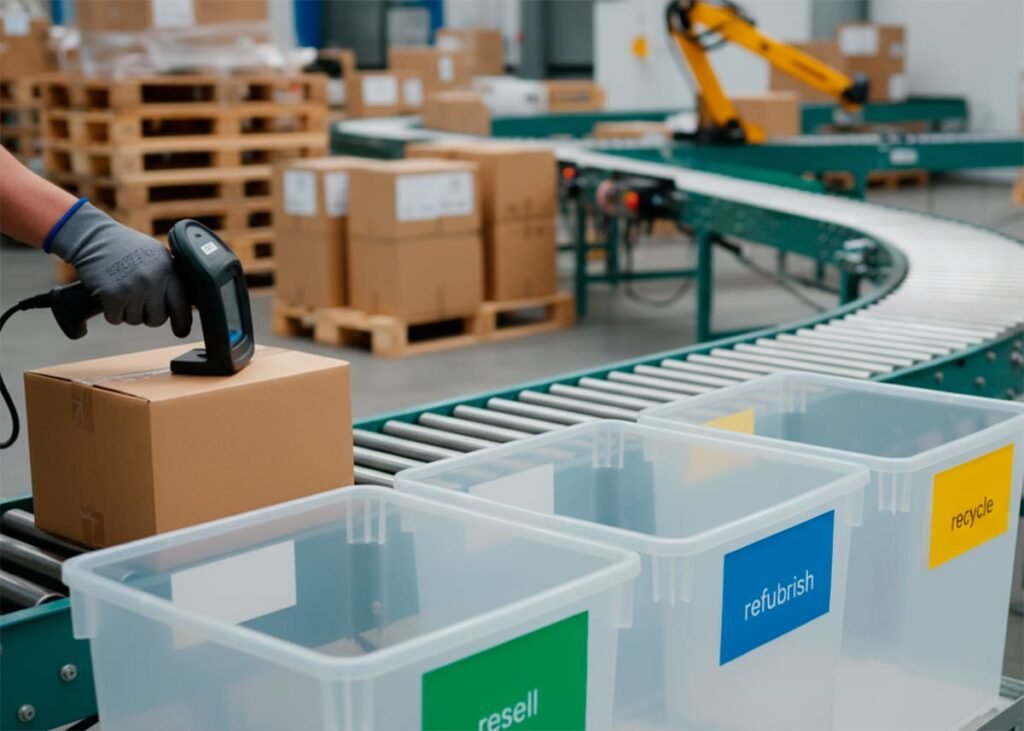
A returned product does not necessarily retain its original selling value. Depending on its condition, packaging, demand, seasonality, and market conditions, the product may be suitable for immediate resale, open-box sales, refurbishment, liquidation, parts recovery, or disposal.
Until that decision is made, the inventory may remain economically unavailable.
For example, a product that could be resold at close to its original price shortly after being returned may lose value if it remains in a returns facility for several days or weeks. Seasonal merchandise can become outdated, electronics can lose market value, and damaged packaging can affect resale opportunities.
This makes the time between receiving a return and determining its disposition an important performance factor. Faster decisions can help businesses recover more value from returned inventory.
Reverse Logistics Requires a Different Strategy
A reverse supply chain does not simply operate as the forward supply chain in the opposite direction.
Outbound shipments typically have a known product, destination, customer, and delivery requirement. Returns introduce uncertainty. Businesses may not know the condition of the product, where it should be sent, whether it can be resold, or which recovery channel will provide the greatest value.
The disposition decision can depend on several factors, including product condition, customer history, demand, repair costs, transportation expenses, fraud risk, and secondary-market opportunities.
For this reason, businesses increasingly need dedicated processes, technologies, metrics, and partners for managing reverse flows.
Cost Per Return Does Not Tell the Whole Story
Reducing the cost of processing individual returns can be useful, but focusing exclusively on that metric may overlook the larger financial picture.
Consider a return operation that processes products at a lower handling cost but takes considerably longer to determine their disposition. Another operation may spend more on processing but return products to inventory or secondary markets much faster.
The second approach could potentially recover more overall value.
Businesses evaluating reverse logistics performance can therefore consider metrics such as:
- Time from return initiation to disposition
- Percentage of returned products restored to primary inventory
- Recovery value from resale and recommerce
- Markdown costs avoided
- Time returned inventory remains unavailable
- Fraud-related losses
- Transportation and handling costs by disposition route
- Customer retention following a return
Looking at these factors together provides a broader view of the financial impact of returns.
Returned Inventory Is Also an Inventory Planning Issue
As return volumes increase, businesses need greater visibility into merchandise that is moving back through the supply chain.
Returned inventory is not immediately equivalent to available inventory. However, products that are inspected, classified, and repositioned quickly may become available for sale much sooner.
Supply chain planners may need to consider questions such as how many products are expected to be returned, what percentage will be suitable for resale, where those products will re-enter inventory, and how quickly they can become available.
This information can also affect replenishment decisions. If products are already moving back into the network, businesses may need to consider that incoming inventory before placing additional replenishment orders.
Connecting returns information with inventory planning, warehouse operations, transportation, and order management can therefore provide a more complete view of product availability. This kind of coordination also highlights why cohesion between different logistics systems and processes is becoming increasingly important.
Fraud Prevention Adds Another Layer
Return fraud creates additional complexity for businesses.
Not every return presents the same level of risk. A product returned shortly after purchase in its original packaging may require a different process from a transaction involving a serial-number mismatch, unusual customer behavior, or other warning signs.
Rather than applying identical restrictions to every customer, businesses can use more detailed return policies and risk assessment processes.
This approach can help companies balance fraud prevention with customer experience. The objective is to identify higher-risk transactions without unnecessarily creating friction for legitimate customers.
Recommerce Creates More Recovery Opportunities
The expansion of resale, refurbishment, repair, and recommerce has created additional options for returned products.
In the past, businesses often relied on a relatively limited set of outcomes, such as returning merchandise to stock, sending it back to a supplier, liquidating it, or disposing of it.
Today, returned products may have multiple potential recovery channels. A product might be refurbished and resold, offered through a secondary marketplace, used for parts, or redirected to a different customer segment.
However, these additional options also require accurate product-condition information, pricing decisions, channel management, and inventory visibility.
As recommerce continues to develop, reverse logistics may become increasingly connected with pricing, inventory planning, order management, and other commercial systems.
Returns Can Provide Valuable Supply Chain Insights
Reverse logistics can also provide information that helps businesses improve their forward supply chains.
Return reasons may reveal problems with product descriptions, sizing, packaging, fulfillment, transportation, supplier quality, or product design.
For example, if a particular product repeatedly comes back because customers received damaged packaging, the issue may need to be addressed earlier in the fulfillment process. If one supplier generates an unusually high number of product-related returns, procurement and quality teams may need to investigate.
The goal is to create a continuous feedback loop:
Sale → Return → Diagnosis → Disposition → Value Recovery → Root-Cause Correction
This allows businesses to use return data not only to recover the value of individual products but also to identify opportunities to reduce future returns.
Conclusion
Reverse logistics is becoming an increasingly important component of modern supply chain management. With retail returns reaching hundreds of billions of dollars annually, businesses can no longer treat returned products as a secondary warehouse issue.
The focus is shifting toward faster disposition decisions, better inventory visibility, stronger fraud controls, expanded recovery channels, and greater integration between reverse and forward supply chain operations.
Businesses that develop effective reverse logistics strategies can potentially recover more value from returned inventory while also gaining insights that improve purchasing, fulfillment, inventory planning, and customer experience. As return volumes continue to grow, reverse logistics will increasingly become part of the broader strategy for managing inventory and protecting margins.
Frequently Asked Questions
Reverse logistics refers to the processes involved in moving products backward through the supply chain after a sale. It can include returns, repairs, refurbishment, resale, recycling, liquidation, and product disposal.
Reverse logistics can affect inventory availability, transportation costs, warehouse operations, customer experience, fraud prevention, and the amount of value businesses recover from returned products.
Businesses can improve reverse logistics by speeding up product inspection and disposition, connecting returns data with inventory planning, using appropriate recovery channels, monitoring return-related metrics, and analyzing return reasons to identify problems in the forward supply chain.