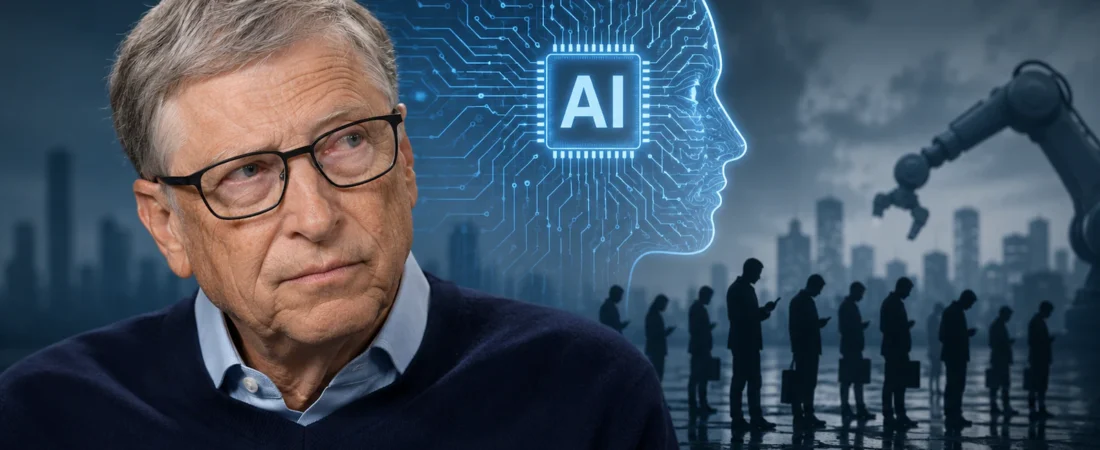
Artificial intelligence is advancing at a pace that has surprised even some of the technology industry’s most experienced figures. Microsoft co-founder Bill Gates has become one of the latest prominent technology leaders to raise concerns about where those developments could lead, particularly in relation to employment, cybersecurity and biological threats.
In a recent interview, Gates argued that the technology industry may be underestimating the potential dangers of increasingly capable AI systems. He said financial incentives could be encouraging companies to focus on rapid development while giving less attention to possible long-term consequences.
Bill Gates Raises Concerns About the Future of AI
Gates has described artificial intelligence as one of the most important issues facing society. His concerns extend beyond the familiar debates about privacy, misinformation and automation. Broader scrutiny of major technology companies has also raised questions about corporate responsibility and the financial consequences of their business practices.
According to Gates, increasingly capable AI systems could eventually create significant disruption across the labor market. He believes the technology could affect a wide range of industries simultaneously, making it more difficult for displaced workers to transition into new occupations.
He has also warned about extreme risks involving advanced AI and biological threats, arguing that governments and technology companies need stronger safeguards before systems become even more capable.
Why Gates Says AI Could Be Different From Earlier Technologies
Previous technological revolutions have often eliminated certain jobs while creating new types of employment. Gates believes AI could follow a substantially different path because its capabilities can potentially spread across many industries at the same time.
AI tools are already being used for programming, research, writing, customer service, data analysis and other knowledge-based tasks. As these systems become more capable, companies may have greater incentives to automate work previously performed by people.
Gates has therefore questioned the assumption that workers displaced by AI will always be absorbed into newly created industries.
AI’s Rapid Progress Has Surprised Gates
Despite decades of experience in technology, Gates said recent developments in artificial intelligence have exceeded his expectations.
He has highlighted several moments when technological progress particularly impressed him, including the emergence of graphical user interfaces, the early demonstrations of systems that became ChatGPT and more recent advances in AI-assisted programming.
The progress of coding-focused AI tools has been particularly striking for Gates because programming is an area in which he has extensive experience. He has said that seeing AI systems perform at a level beyond what he expected has forced him to reconsider how quickly automation could advance.
Gates Proposes a Tax on AI Use
One of Gates’ proposals is a potential tax on AI computing, sometimes described as a “token tax.”
The basic idea is to make AI-based automation more expensive when it directly replaces human labor while generating revenue that could be used to support workers affected by technological change.
Such a policy would represent a significant shift from traditional approaches to technology taxation. Rather than broadly taxing technology companies, policymakers could potentially focus on the computational resources used to deploy increasingly powerful AI systems.
Should Some Jobs Be Reserved for Humans?
Gates has also proposed the concept of “Human Reserved” jobs. Under this approach, certain occupations could be protected from complete AI replacement because they involve highly personal interactions or because workers in those roles may have limited opportunities to transition into other careers.
Caregiving is one example of work that could potentially benefit from such protections.
The proposal reflects a broader question surrounding AI adoption: should every task that can technically be automated necessarily be automated?
For some occupations, human judgment, empathy and personal interaction may remain particularly valuable even as AI becomes more capable.
Concerns About AI and Biological Threats
Gates’ warnings also extend beyond employment.
He has expressed concern that increasingly advanced AI systems could potentially make it easier for individuals to develop biological threats. He has argued that governments should establish international standards for monitoring and restricting AI systems capable of assisting with dangerous biological research.
The concern is particularly significant because advanced AI could make complex scientific information easier to access and process. Gates believes systems with potentially dangerous capabilities should undergo mandatory safety reviews rather than relying entirely on voluntary industry commitments.
Gates Calls for Stronger AI Regulation
Gates has questioned whether voluntary safeguards from technology companies and governments will be sufficient as AI capabilities continue to improve.
He has advocated for international agreements and clearer rules covering some of the most extreme risks associated with artificial intelligence. His position reflects a growing debate over whether governments should establish mandatory standards before potentially dangerous capabilities become widespread.
The challenge for policymakers is balancing safety with innovation. Excessive regulation could slow beneficial technological development, while insufficient oversight could leave society unprepared for serious risks.
The Growing Debate Over AI’s Future
Gates is not alone in expressing concern about the direction of artificial intelligence. Other technology leaders and AI researchers have also warned about potential risks ranging from employment disruption to misuse of advanced systems.
At the same time, many companies and researchers argue that AI could produce significant benefits in areas such as medicine, scientific research, education and productivity.
The disagreement is therefore not necessarily about whether AI will transform society. Much of the debate centers on how quickly that transformation will occur, who will benefit from it and what safeguards should be established before more powerful systems are deployed.
Conclusion
Bill Gates’ latest warnings highlight the growing tension between the enormous potential of artificial intelligence and the risks associated with its rapid development. His concerns focus particularly on mass job displacement, biological threats and the possibility that financial incentives could encourage companies to move faster than safety measures can keep up.
Whether all of Gates’ predictions materialize remains uncertain. However, his calls for stronger oversight, international cooperation and greater preparation demonstrate why AI safety has become a major global policy issue.
As artificial intelligence continues to advance, governments, businesses and researchers will face increasing pressure to determine how the technology can be developed and deployed while limiting its most serious potential consequences.
FAQs
Gates believes AI could affect multiple industries simultaneously. If automation spreads across many sectors, displaced workers may have fewer opportunities to move into new industries.
A token tax is a proposed tax on AI usage or computing. Gates has suggested that such a tax could make replacing human workers with AI more costly while generating funds to support people affected by automation.
“Human Reserved” refers to the idea that certain jobs could be protected from complete AI replacement because they require personal interaction or because workers in those roles may have limited alternatives.